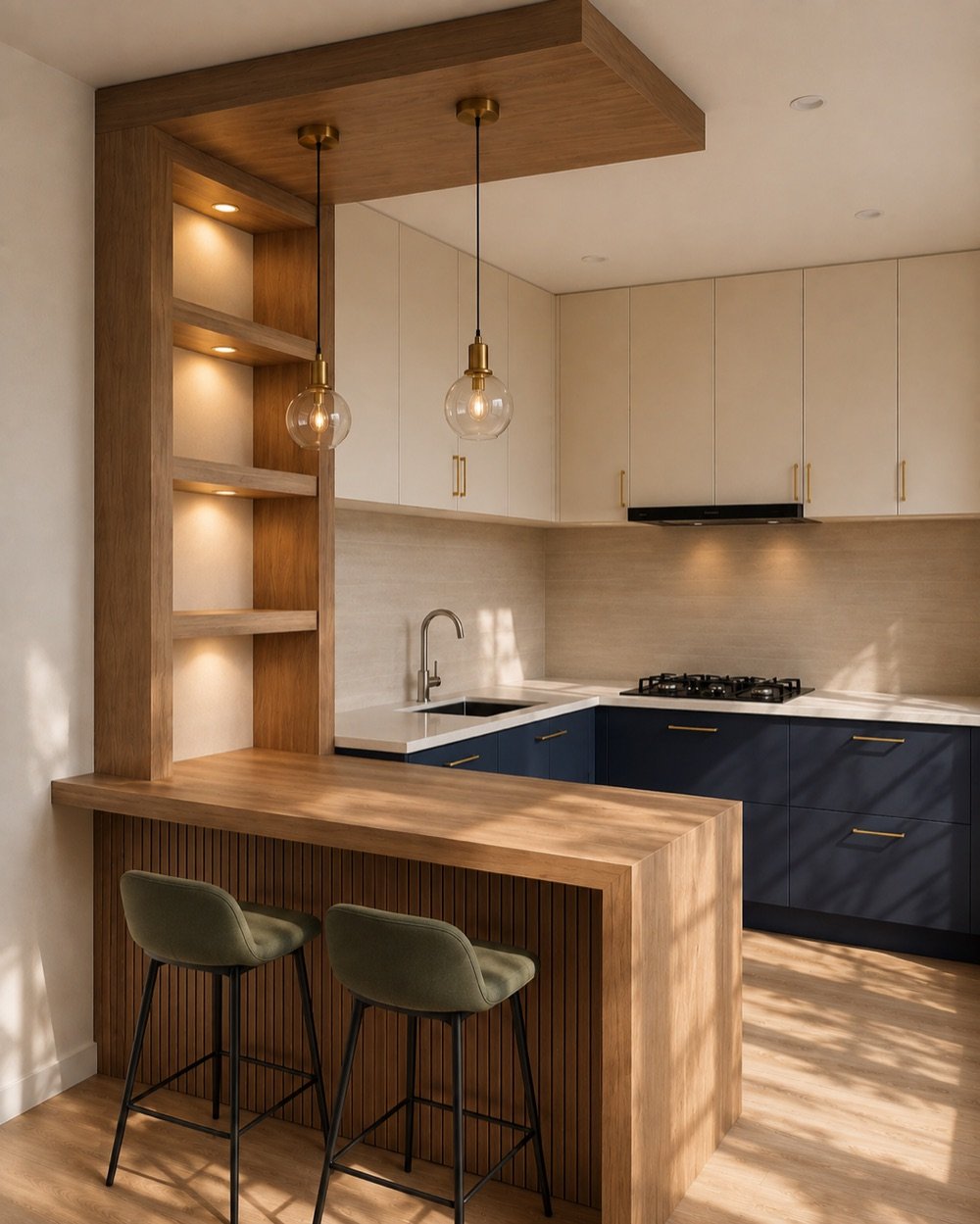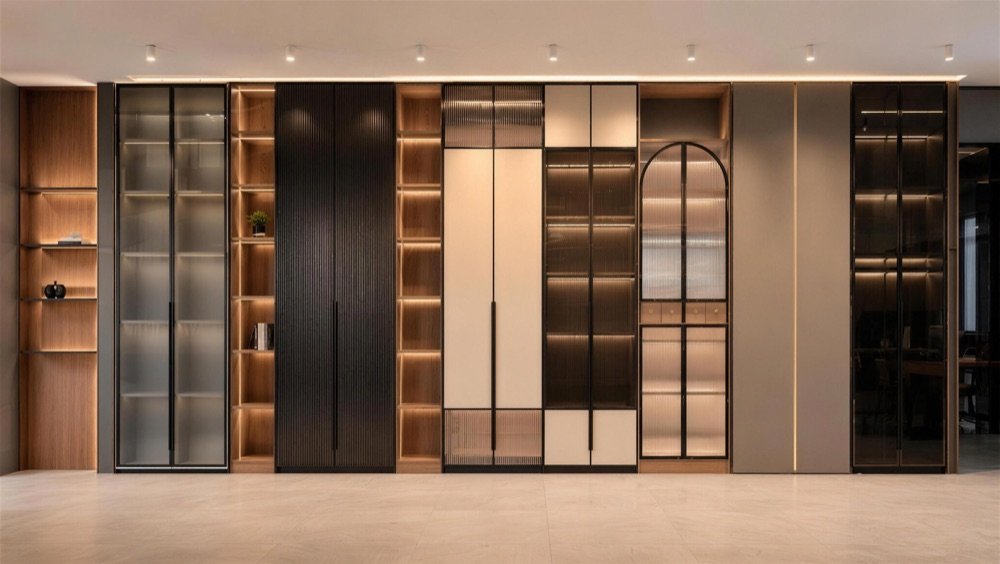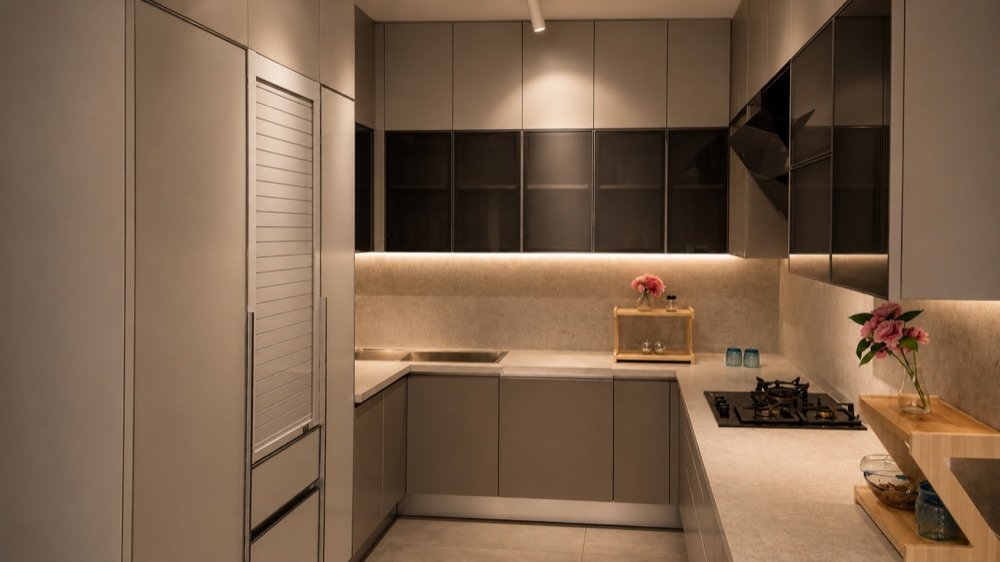
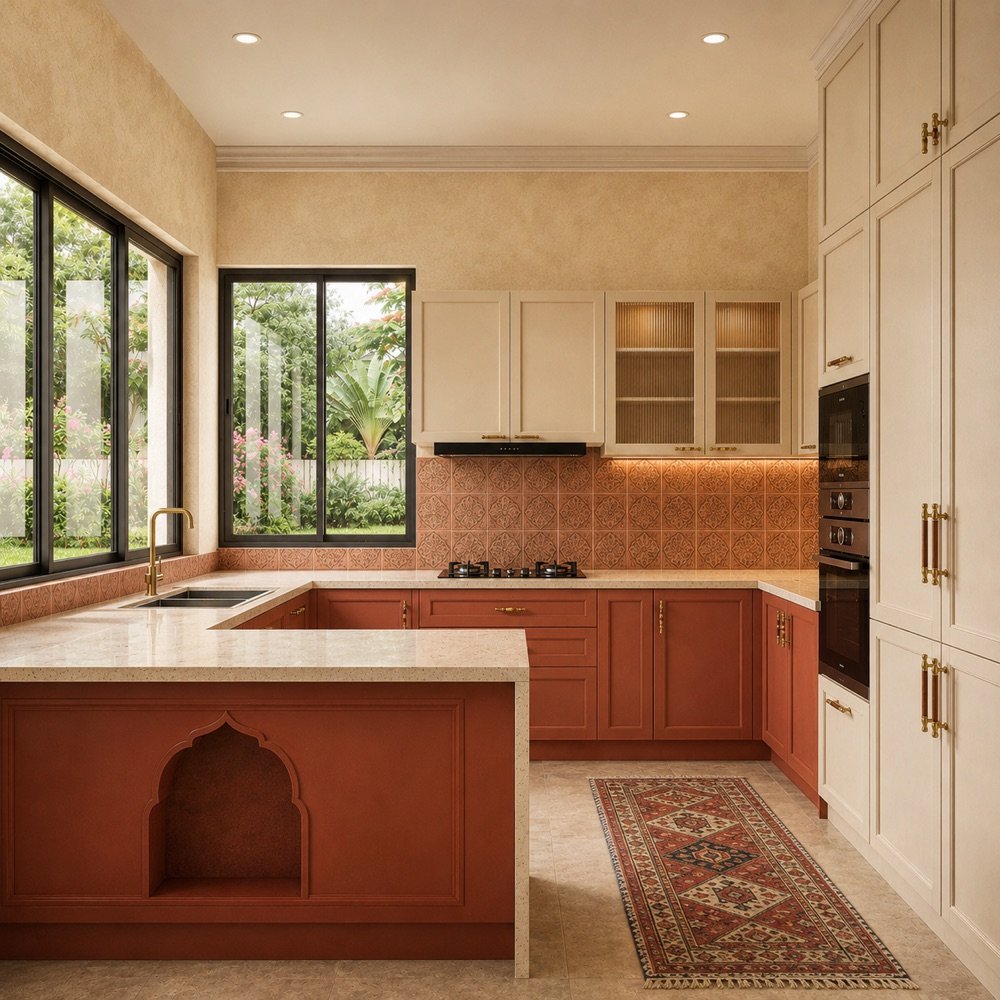
Shutters and handles are the bit you fall in love with. The board underneath is the bit that decides whether you're still in love in ten years. So let's talk about the boring part, because the boring part is where the money really goes.
The four names you'll hear
Plywood is thin sheets of real wood glued in layers, with the grain of each layer running across the last. That cross-graining is why it's strong, holds a screw well, and doesn't sag over a long span. Marine or BWP-grade plywood is bonded with a phenolic glue that stands up to moisture; commercial or MR-grade is not, and shouldn't go near a sink.
MDF is wood fibre pressed with resin into a perfectly smooth, perfectly uniform board. That smoothness is a real advantage. It takes paint, lacquer and membrane finishes beautifully, with none of the grain telegraphing through. Its weakness is water: ordinary MDF swells irreversibly if it gets properly wet, and it holds a screw less well than ply.
HDHMR, high-density high-moisture-resistant board, is the middle ground, and it's become very popular here for good reason. It's denser than MDF, more moisture-tolerant, holds screws better, and still finishes smoothly. It's heavier and costs a little more.
Particle board is chips and glue. It's cheap, it's light, and it belongs in furniture you expect to replace. It has no place in a fitted kitchen you're paying good money for, whatever anyone tells you.
You are not really choosing a material. You are choosing how much moisture each part of your home is going to see, and matching the board to it.
So what should go where?
- Kitchen base units, and anything under the sink, BWP plywood. This is not the place to save money. Water finds this cabinet eventually.
- Kitchen wall units, BWP ply or HDHMR. Steam rises, so don't drop to ordinary MDF up here.
- Shutters you want painted or in a flat colour, HDHMR or MDF. They give the smoothest possible face, and a painted ply shutter will always show a little grain.
- Bedroom wardrobes, MR plywood or HDHMR is plenty, unless the wardrobe shares a wall with a bathroom.
- Long open shelves, 19mm plywood. MDF will sag over a metre with books on it, and it will not recover.
- Loft and dry storage, HDHMR is perfectly sensible and saves a bit.
The finish on top
Laminate is the practical everyday choice, tough, endlessly varied, easy to live with, and easy to clean. Acrylic gives you that deep mirror gloss, and it is genuinely beautiful; just know that it shows every fingerprint, so it's happiest above eye level or on a wardrobe rather than around a busy hob. PU paint is the most luxurious and the most repairable, if it's damaged, it can be sanded and resprayed in place, which nothing else on this list can do. Membrane or foil is the friendliest way to get a shaker-style routed shutter without the cost of solid timber, though the edges are its weak point over many years.
The unglamorous details that matter most
Two things quietly decide how long a kitchen lasts, and neither of them appears in a mood board.
The first is edge banding. Every cut edge of a board is an open mouth waiting for moisture. A proper 2mm PVC edge band, machine-pressed, seals it. A thin 0.8mm band applied in a hurry will lift at a corner within two years and then the board starts to swell from that corner outwards. When you're comparing quotes, ask specifically what thickness of edge band is included. It's a small line item and a very reliable signal of how carefully the rest is being made.
The second is hardware. Hinges and drawer runners are opened and closed tens of thousands of times. Good soft-close hardware from a known maker will outlast the cabinet; cheap hardware starts to sag inside a year, and then every door in the kitchen looks slightly crooked. If your budget has to give somewhere, let it give on the finish, never on the hinges.
Two things worth checking for your own peace of mind
Ask whether the plywood is ISI-marked, IS:710 for BWP grade, IS:303 for MR. And if anyone in the house has allergies or asthma, ask about the formaldehyde emission class of the boards; E1 or better is what you want, and any decent manufacturer will know their answer immediately.
None of this is glamorous. But the day your neighbour's shutters start to swell at the bottom and yours don't, you'll be quietly glad you asked.
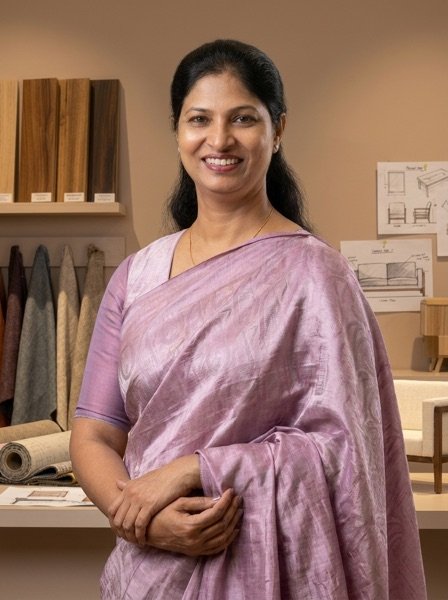
Jenitha started Aarcube in 2014 after building her own home and finding the whole process needlessly complicated. She has been quietly trying to fix that ever since.